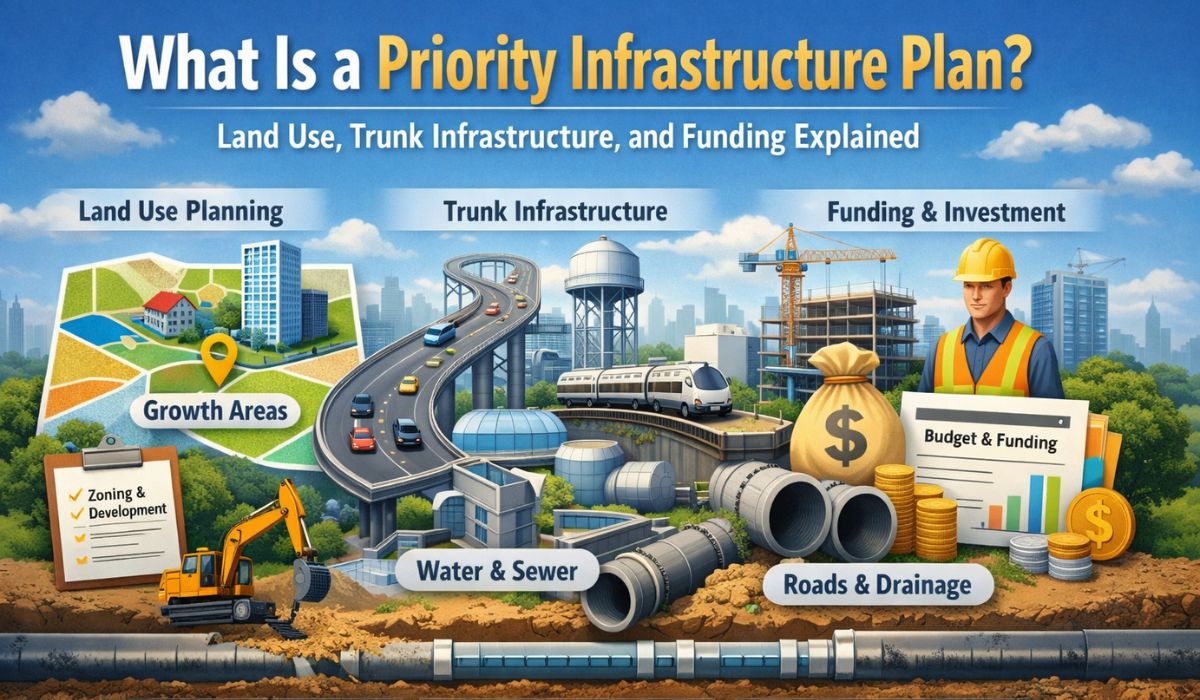
A Priority Infrastructure Plan is a planning tool that helps a city, region, or local authority decide what major public infrastructure is needed, where it should go, when it should be delivered, and how it may be funded. It is closely tied to land use planning because roads, water systems, drainage, parks, and other public networks must be ready to support homes, businesses, schools, and services as an area grows. Without a clear plan, development can move faster than public systems, which often leads to congestion, service gaps, rising costs, and pressure on existing communities.
This kind of plan matters because growth does not happen in a neat, simple way. New housing areas may need roads, pipes, transport links, and open space before large numbers of people move in. Business districts may need better freight access, stronger utilities, and more reliable public services. A well-prepared infrastructure framework gives decision-makers a practical map for matching future development with the systems that make daily life work. It also gives developers, residents, and public agencies a clearer view of what is expected over time.
Why This Type of Plan Matters
At its core, a Priority Infrastructure Plan is about order. It helps local governments and planning bodies avoid random decisions by setting out which projects are most important and why they should come first. That could mean a new trunk road that opens access to a growth area, a wastewater upgrade that supports higher-density housing, or a stormwater system that reduces flood risk before new construction begins. The plan creates a line between ambition and delivery by asking what can realistically be built, what should be staged, and what will serve the broader public interest.
It also helps balance short-term needs with long-term goals. Some communities need immediate upgrades because existing infrastructure is already under strain. Others are planning for future expansion and need to reserve land, budget funds, and coordinate agencies before growth arrives. In both cases, a strong planning document reduces uncertainty. It does not solve every problem, but it gives a structure for dealing with growth, investment, and public expectations in a more disciplined way.
The Link Between Land Use and Infrastructure
Land use planning decides how land is expected to develop over time. It shapes where people may live, where shops and offices may be built, where industrial areas may expand, and where open space should be protected. Infrastructure planning supports those land decisions by making sure the physical systems under and around development can carry the load. If land is zoned for more homes but the roads, water supply, or drainage are not upgraded, the planning decision may look good on paper but fail in real life.
That is why a Priority Infrastructure Plan is usually tied closely to future growth patterns. It looks at population change, housing demand, transport movements, service needs, and community expectations. It then asks how these patterns affect major public networks. In simple terms, land use shows where change may happen, while the infrastructure plan shows what must be built or improved so that change can happen in a workable and fair way.
ALSO READ THIS :- What Is a Messeregge? A Simple Guide to Its Role in Modern Farming
What “Trunk Infrastructure” Means
One of the most important ideas in this topic is trunk infrastructure. This term usually refers to the major shared systems that serve broad areas rather than a single building site. Examples often include main roads, major water mains, bulk sewer networks, drainage channels, regional parks, transport corridors, and other backbone assets that support many users at once. These are the big public systems that connect neighborhoods and help entire districts function.
This is different from smaller local works that serve only one development or a very limited area. A new driveway, a short internal access road, or on-site drainage inside a private project is usually not viewed the same way as a regional transport route or a major water upgrade. The point of focusing on trunk infrastructure is to plan the larger network early, because these systems are expensive, land-hungry, and difficult to add later once development has already spread.
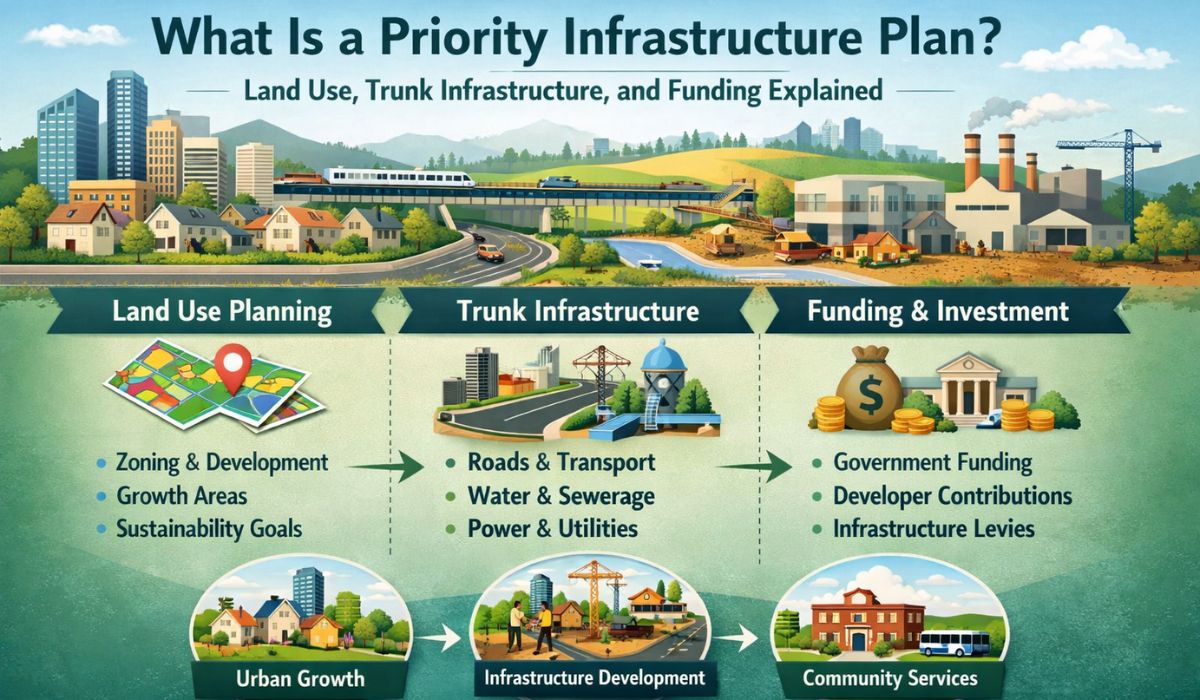
What a Priority Infrastructure Plan Usually Covers
Although the details vary from place to place, most plans cover a similar group of services and assets. They normally look at where future growth will happen, what major infrastructure is needed to support that growth, and how delivery should be staged over time. They may also identify priority service areas, likely costs, possible funding methods, and the standards used to decide what level of service the public should receive.
A clear plan often brings together information that would otherwise sit in separate technical files. That includes transport planning, utility capacity, flood management, public open space needs, community facility demand, and capital works timing. Putting those pieces into one framework makes it easier for governments, planners, engineers, and developers to work from the same assumptions instead of moving in different directions.
Common Elements Inside the Plan
Most strong infrastructure plans include a few core parts that help turn broad policy into practical action. These parts give the document its working structure and help people understand not only what is needed, but also why it is needed and when it may happen.
- growth forecasts for population, housing, jobs, and service demand
- mapped areas showing where major development is expected
- identified trunk assets such as roads, water, sewer, drainage, and parks
- project timing or staging across short, medium, and longer terms
- estimated costs and likely funding paths
- service standards that explain the level of public infrastructure expected
- delivery priorities based on urgency, need, and long-term benefit
How Priority Is Decided
Not every project can be built at once, so priority setting is one of the most important parts of the process. A project may be ranked highly because it unlocks a large housing area, fixes a major service failure, reduces safety risks, or supports a wider network that many people depend on. In other cases, a project may be delayed because growth is not yet strong enough to justify the cost, or because another piece of infrastructure must come first.
This is where planning becomes both technical and political. Engineers may focus on capacity and system performance. Financial teams may focus on affordability and timing. Elected leaders may focus on community pressure and visible outcomes. A good plan does not erase these tensions, but it makes the decision-making process more transparent. It sets criteria so that priorities are not chosen only by pressure, habit, or short-term convenience.
Funding and Cost Recovery
Funding is one of the hardest parts of any infrastructure conversation. Major public works are costly, and many local governments do not have unlimited budgets. A Priority Infrastructure Plan helps by setting out likely project costs and identifying how money may be raised over time. That may include public budgets, infrastructure charges, developer contributions, borrowing, grants, staged delivery, or a mix of several methods.
The funding section is important because good ideas often fail when there is no realistic path to pay for them. A road on a map is not the same as a funded project in a delivery program. By linking projects to likely funding approaches, the plan becomes more than a wish list. It starts to act as a practical framework for capital planning, budget decisions, and negotiations between public agencies and private development interests.
How Developers and Communities Are Affected
These plans affect both private development and everyday community life. For developers, they create more certainty about what infrastructure may be required, where service areas are expected to expand, and how charges or delivery obligations may be structured. That can help with project planning, land valuation, and timing decisions. Clear rules are usually easier to work with than unclear expectations that shift from one application to the next.
For residents, the impact is often felt in more direct ways. A good infrastructure plan can support better roads, safer drainage, improved parks, stronger utility services, and more reliable public transport connections. It can also help reduce unfair outcomes, such as one neighborhood carrying the pressure of growth while public investment falls behind. When prepared well, the plan becomes a tool for fairness as much as efficiency.
Challenges and Limits
Even the best plan has limits. Growth forecasts can be wrong. Construction costs can rise quickly. Political priorities may shift after elections. Environmental conditions can change, especially in areas facing flood risk, water stress, or climate pressure. In some places, land needed for future infrastructure may become harder to secure if planning is delayed too long. These risks mean the plan must be reviewed and updated rather than treated as a fixed document forever.
Another challenge is coordination. Roads, utilities, housing, schools, and open space are often handled by different agencies or funding streams. If those groups do not work well together, the plan may look strong on paper but stall in practice. This is why implementation matters just as much as drafting. A document only adds value when it is linked to budgets, approvals, engineering programs, and regular decision-making.
ALSO READ THIS :- Fisila Information Hub: Basic Facts Made Easy to Understand
Why Timing and Staging Matter
Staging is a major part of success. Infrastructure delivered too early can place heavy costs on the public before there is enough demand. Delivered too late, it can create overcrowding, delays, and service failures. A strong planning approach tries to match timing with actual growth so that capacity expands in a sensible way. This often means dividing projects into phases and linking each phase to measurable triggers such as population growth, development activity, or system demand.
Timing also affects public trust. Communities are more likely to support growth when they can see that roads, drainage, parks, and utilities are being planned in step with new development. When growth arrives first and infrastructure comes much later, people often feel that planning has failed them. A good plan cannot remove every delay, but it can show that timing has been considered carefully instead of ignored.
What Makes a Strong Plan
A strong Priority Infrastructure Plan is clear, realistic, and usable. It does not hide behind vague language or endless technical detail. It explains what growth is expected, what trunk infrastructure is needed, what service standards apply, what areas are likely to be served, what projects matter most, and how the funding path may work. It should also be readable enough for non-specialists, because infrastructure choices affect the whole community, not only planners and engineers.
The strongest plans also leave room for review. Cities change. Economies move. Population patterns shift. Good planning is not rigid; it is structured but adaptable. That balance matters because a plan that cannot respond to new facts will quickly become outdated. A useful framework guides decisions while still allowing updates when conditions change on the ground.
Final Thoughts
A Priority Infrastructure Plan is not just a technical document. It is a practical tool for managing growth, guiding land use, protecting service quality, and connecting public investment to real needs. By focusing on trunk infrastructure, staging, and funding, it helps communities think ahead instead of reacting after problems appear. It also creates a shared basis for decision-making between governments, developers, and residents.
In simple terms, the value of this type of plan lies in coordination. It brings together where growth is expected, what major systems are needed, who may help pay for them, and when they should be delivered. When done well, it supports stronger communities, better public services, and more predictable development outcomes. That is why it remains such an important part of modern urban and regional planning.
FAQs
1. What is the main purpose of a Priority Infrastructure Plan?
Its main purpose is to match future development with the public infrastructure needed to support it. It helps decision-makers plan major systems in an orderly way instead of reacting after growth has already created pressure.
2. What is meant by trunk infrastructure?
Trunk infrastructure means the major shared networks that serve wide areas, not just one private site. This often includes main roads, water supply systems, sewer networks, drainage systems, parks, and major service corridors.
3. How does land use planning connect to infrastructure planning?
Land use planning decides where homes, businesses, and services may grow. Infrastructure planning then makes sure those areas can function by providing the roads, utilities, drainage, and public assets needed to support that growth.
4. Who pays for the infrastructure in these plans?
Funding can come from several sources, including public budgets, grants, borrowing, infrastructure charges, and developer contributions. In many cases, the final funding model is a mix rather than a single source.
5. Why are project priorities necessary?
Priorities are necessary because governments cannot build every project at once. Ranking projects helps focus money and effort on the works that solve urgent needs, unlock growth, or provide the greatest long-term public benefit.
6. Can a Priority Infrastructure Plan change over time?
Yes, and it usually should. Costs, growth rates, environmental conditions, and public needs can change, so the plan must be reviewed and updated to stay useful and realistic.
FOR MORE CONTENT: CLOCKMAGAZINE