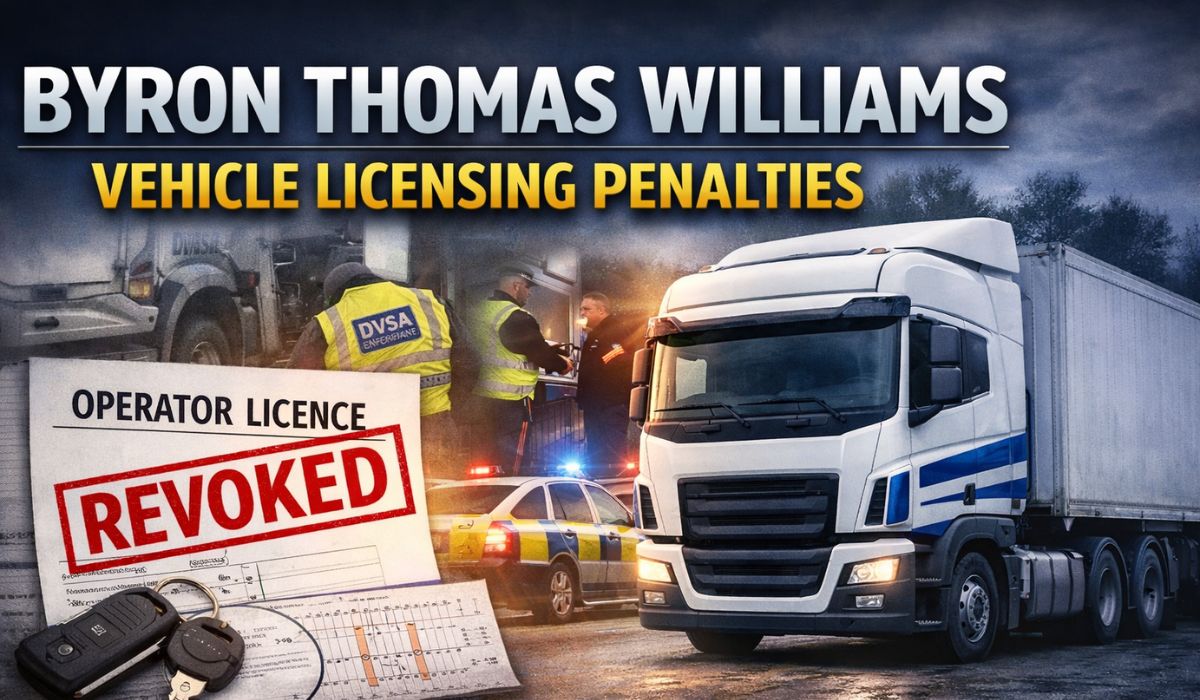
The topic of Byron Thomas Williams Vehicle Licensing Penalties has drawn attention because it touches on a part of road transport that many people never think about until something goes wrong. Operator licensing is not just paperwork. It is a legal system designed to make sure heavy goods vehicles are run safely, maintained properly, and managed by people who understand their duties. When those duties are ignored, the consequences can be serious for a company, its drivers, and everyone else on the road.
This case matters because it is not simply about one business being punished. It also shows how transport rules work in practice. A licence can be restricted, suspended, or revoked when the Traffic Commissioner decides that an operator is no longer meeting the standards required to stay in business. In this situation, the case involved BTW Transport Ltd, its director Byron Thomas Williams, and findings linked to maintenance, recordkeeping, roadworthiness, and the continued use of vehicles after the licence position had already become a major legal issue.
What an Operator Licence Actually Means
An operator licence is a legal permission to use certain goods vehicles for business purposes. In simple terms, it is one of the foundations of lawful transport work in Great Britain. Holding a licence does not only mean a company can put trucks on the road. It also means the operator promises to keep vehicles safe, inspect them at set intervals, record defects honestly, manage drivers correctly, and report important changes to the regulator. When those promises are broken, the issue becomes much bigger than an ordinary business mistake.
That is why licence revocation is seen as one of the strongest actions available. It can stop a transport business from operating and can also affect a director’s future role in the sector. In the Byron Thomas Williams matter, the official decision recorded revocation of the operator’s licence, a 12-month disqualification for the company from holding or obtaining another operator’s licence, and a matching 12-month disqualification for the director from holding or obtaining such a licence or being a director of a company that does so. Those penalties show how seriously the system treats repeated non-compliance.
The Background of the Case
BTW Transport Ltd held a standard national goods vehicle operator’s licence and was authorized to use seven vehicles and eight trailers. Byron Williams, also referred to in the record as Byron Thomas Williams, was the sole director. The case did not begin with a single dramatic event. Instead, the official material shows a pattern of problems that built over time, with enforcement attention increasing after multiple signs that the operator’s systems were not working the way they should.
One early trigger came in January 2024, when one of the operator’s vehicles was found to have loose wheel nuts at annual test and received an immediate prohibition marked as serious. That led to closer scrutiny by the Driver and Vehicle Standards Agency. A maintenance investigation visit in March 2024 found unsatisfactory areas of compliance, including poorly completed preventive maintenance inspection sheets, inaccurate entries, missing evidence of proper brake testing, and weak driver defect reporting. These were not minor presentation issues. They raised questions about whether the transport operation was genuinely under control.
Why the Penalties Became So Serious
The official findings point to a combination of safety concerns and management failures. Records suggested that inspection paperwork referred to parts not even fitted to the vehicles concerned. Drivers did not always report defects that should have been obvious. There were repeated tyre problems, including serious prohibitions. Vehicles were also found without valid excise duty, and one vehicle had not been properly specified on the licence when encountered. Taken together, these points created a picture of a business with weak systems and poor compliance discipline.
The matter became even more damaging because the inquiry concluded that vehicles continued to be used for three weeks when Byron Williams knew the operator’s licence had been revoked on 6 November 2024, even though that decision was being contested. The official press release stated that he knowingly allowed vehicles to operate without valid excise duty, which gave the operator an unfair commercial advantage. That kind of conduct goes beyond carelessness. It directly affects trust, which is central to the licensing system.
ALSO READ THIS :- Kotora Melnkalne Guide: Old Town, Bay Views, and Hidden Spots
Main Issues Identified by the Inquiry
The public material around the case shows that the penalties were tied to a broad pattern of non-compliance, not one isolated breach. The main concerns included:
- inaccurate maintenance and PMI records
- weak or ineffective driver defect reporting
- missing or inconsistent brake testing
- multiple tyre-related safety prohibitions
- vehicles used without valid excise duty
- failure to report a maintenance provider change
- vehicles not inspected at agreed intervals
- vehicle use after the licence had already been revoked
That list helps explain why the case has attracted attention. It brings together legal, technical, and management failures all at once. A transport business can sometimes recover from a single lapse if it responds quickly and honestly. It becomes much harder when the regulator sees repeated faults, unreliable records, and conduct that appears to show disregard for the rules. In this case, the decision and related reporting described a catalogue of errors and attempts to mislead, which made the final outcome much more severe.
What Licence Revocation Means in Practice
When an operator’s licence is revoked, the effect is immediate and practical. The business loses the legal basis to continue using the vehicles covered by that licence for the regulated work it had been carrying out. In the official decision, the revocation took effect at 23:45 on 22 October 2025. The company was then disqualified for 12 months, until 22 October 2026, from holding or obtaining any type of operator’s licence in any traffic area.
For Byron Thomas Williams personally, the consequences also reached beyond the company itself. The decision stated that he was disqualified for the same 12-month period from holding or obtaining any operator’s licence and from being a director of any company holding or obtaining such a licence. That matters because it shows the penalties were not limited to the corporate entity. The regulator viewed the director’s conduct as central to the compliance problems and treated personal responsibility as part of the outcome.
Why Recordkeeping Matters So Much
To outsiders, paperwork can seem like the least important part of road safety. In transport regulation, it is often the opposite. Good records are the evidence that inspections happened, brakes were tested, tyre conditions were checked, defects were logged, and repairs were completed properly. If records are missing, unclear, or inaccurate, regulators may conclude that the system behind them is also weak. In the Williams case, inaccurate maintenance documents and poor audit trails were a major part of the concern.
This is one reason operator licensing cases are often about more than the final defect found at the roadside. A worn tyre or a vehicle without valid tax may be the visible problem, but the deeper question is whether the business has a reliable culture of compliance. If a company cannot show clear, honest, and consistent documentation, it becomes much harder to persuade the regulator that the risks are under control. The Byron Thomas Williams vehicle licensing penalties illustrate that point very clearly.
The Role of the Transport Manager
Another important part of the case involved the transport manager function. In operator licensing, the transport manager is expected to exercise effective and continuous management of the transport activities. That includes overseeing roadworthiness systems, compliance processes, and driver-related controls. The official decision notes that concerns were raised about whether effective control was being exercised and also records the later loss of good repute and disqualification of the former transport manager, Nichola Ogilvie, until further order.
This part of the story is important because it shows that transport compliance is not carried by one title alone. A director cannot simply assume someone else will solve every operational issue, and a transport manager cannot be effective without proper authority, access, and support. The official materials mention problems with access to systems and records, reminders about vehicle excise duty, and later concerns raised when the former transport manager resigned. All of that helps explain why the case became a wider lesson in management failure rather than a narrow technical dispute.
ALSO READ THIS :- Courseto Learning Guide: Affordable Courses, Flexible Study, and Career Skills
What This Case Teaches Operators
The clearest lesson is that small failures do not stay small when they are repeated. A missed inspection, an unchecked document, or a defect report that is not taken seriously can become part of a larger pattern. Once that pattern suggests a lack of control, the regulator may decide the operator is no longer fit to hold a licence. The Williams case shows how issues involving tyres, brake testing, taxation, maintenance intervals, and honesty in records can combine into one very damaging result.
It also teaches that challenging a decision does not create permission to ignore it. One of the most serious findings was the continued use of vehicles after the licence had been revoked. For any operator, that is a warning that legal process must be respected exactly as it stands at the time. Hoping that a decision may later change is not the same thing as having lawful authority in the present. That difference can shape the entire outcome of a case.
Why This Topic Matters Beyond One Company
Many readers will come to this subject because they want to understand one name and one case. Yet the wider importance is bigger than that. Commercial vehicles share roads with families, workers, school traffic, and everyday drivers. A poorly maintained heavy vehicle is not only a business problem. It is a public safety issue. That is why transport penalties can look strict compared with penalties in some other industries. The goal is not only punishment. It is prevention.
The case also explains why regulators focus so much on trust. A business may make mistakes and still recover if it shows honesty, fast correction, and a genuine commitment to improving systems. But where the decision-maker loses confidence in the operator’s truthfulness, judgment, or willingness to follow the law, the path back becomes much harder. That is one of the strongest messages carried by the Byron Thomas Williams Vehicle Licensing Penalties case and the operator licence revocation that followed.
Final Thoughts
The story behind Byron Thomas Williams Vehicle Licensing Penalties is really a story about how operator licensing works when standards break down. The penalties did not arise from one clerical mistake or one unlucky inspection. They followed a wider picture of unsafe maintenance controls, weak reporting systems, vehicle excise issues, breaches of licence conditions, and the continued use of vehicles after the licence position had already become critical. The result was licence revocation, company disqualification, director disqualification, and long-term damage to business credibility.
For readers trying to understand the case in plain language, the core message is simple. Operator licences come with real responsibilities, and those responsibilities must be met every day, not only when an inspection is expected. When a company fails to keep accurate records, fails to maintain vehicles properly, and fails to respect the legal limits of its licence, the penalties can be severe. This case stands as a clear reminder that transport compliance is not optional, and that public safety remains at the center of the whole system.
FAQs
1. What are Byron Thomas Williams vehicle licensing penalties?
This phrase refers to the penalties linked to the official case involving BTW Transport Ltd and its director, Byron Thomas Williams. The recorded outcome included operator licence revocation and a 12-month disqualification affecting both the company and the director.
2. Why was the operator licence revoked?
The licence was revoked after a public inquiry found repeated failures in maintenance, driver management, and regulatory compliance. The official findings also referred to inaccurate records, safety problems, and the use of vehicles after the licence had already been revoked.
3. What is an operator licence in simple terms?
An operator licence is a legal authorization that allows a business to use goods vehicles for certain transport activities. It comes with strict duties involving roadworthiness, inspections, defect reporting, and compliance with licence conditions.
4. How long did the disqualification last?
According to the official decision, the company and Byron Thomas Williams were disqualified for 12 months. The period ran from 23 October 2025 until 22 October 2026.
5. Did the case involve only paperwork issues?
No. Although poor records were a major issue, the case also involved serious safety and compliance concerns. These included defective tyres, weak brake testing evidence, ineffective defect reporting, and vehicle excise problems.
6. Why does this case matter to other transport businesses?
It matters because it shows how repeated non-compliance can lead to loss of licence and loss of trust from the regulator. It is a warning that transport businesses must treat maintenance, record accuracy, and legal compliance as daily responsibilities, not occasional tasks.
FOR MORE CONTENT: CLOCKMAGAZINE