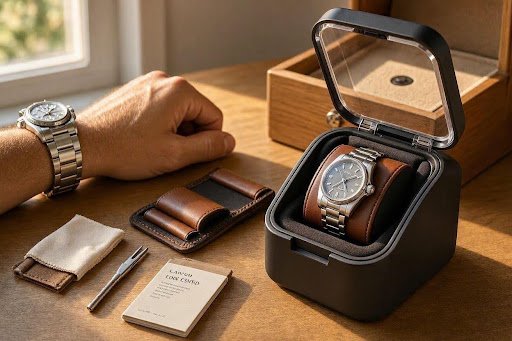
If you own a Rolex, you already know it isn’t just a watch. It’s a mechanical instrument built to run for decades, and how you treat it between wears matters more than most owners realise. One question comes up again and again among new and experienced collectors alike: does a Rolex actually need a watch winder, or is that just clever marketing from accessory brands?
The short answer is that it depends on how often you wear the watch and how many automatic pieces you own. A Rolex worn daily needs nothing more than your wrist. A Rolex that sits in a drawer for weeks at a time tells a different story, and that’s where a winder earns its place.
This guide breaks down exactly how Rolex movements work, when a winder genuinely helps, when it doesn’t, and how to store your collection properly so every piece stays accurate and ready to wear.
How a Rolex Movement Actually Works
Every modern Rolex uses a self-winding mechanical movement called a Perpetual movement. Inside the case sits a semicircular rotor that swings freely with the motion of your wrist. As it swings, it winds the mainspring, which stores the energy that powers the watch.
Once fully wound, a Rolex Perpetual movement typically runs for around 70 hours without being worn, thanks to Rolex’s long-standing Chronergy escapement and modern barrel design. Older models and some references without the extended power reserve tend to run closer to 48 hours.
This matters because it sets the real threshold for when a watch stops. Wear your Rolex most days and the rotor keeps the mainspring topped up without any help. Leave it off your wrist for three or four days and it will wind down, stop, and need resetting.
So Does Your Rolex Actually Need a Winder?
Here’s the direct answer: a watch winder isn’t essential for a single Rolex worn regularly. It becomes genuinely useful in three specific situations.
You Own More Than One Automatic Watch
This is the most common reason collectors buy a winder. If you rotate between two, three, or more automatic watches, each one stops the moment it’s not being worn for a few days. Restarting a Rolex means resetting the time and, on date models, carefully advancing the date wheel, which is a fiddly process compared with just picking up a watch that’s already keeping perfect time.
You Travel Frequently or Rotate Seasonal Pieces
Anyone who wears a Rolex only on weekends, or switches watches by season or occasion, faces the same stop-start problem. A winder keeps the watch powered and accurate, so it’s ready the moment you want to wear it again.
You Own a Complicated or GMT Model
Models with a date complication, GMT function, or annual calendar are more tedious to reset than a simple three-hand watch. A winder removes that hassle entirely by keeping the movement running continuously.
If none of these apply to you and you wear the same Rolex most days, save your money. A watch box with proper cushioning does the job just as well for storage, and winding it back up by wearing it takes seconds.
Choosing the Right Watch Winder for a Rolex
Not every winder suits every Rolex calibre, and getting the settings wrong can be as unhelpful as not using one at all.
Turns Per Day (TPD)
Rolex movements generally need a TPD setting between 650 and 950, depending on the calibre. Checking your specific reference before you buy or program a winder avoids under-winding, which leaves the watch running low, or over-stressing the automatic mechanism through excessive rotation.
Winding Direction
Most modern Rolex movements wind bidirectionally, meaning the rotor charges the mainspring whether it spins clockwise or anticlockwise. This makes Rolex watches relatively easy to accommodate, since you don’t need to hunt for a unidirectional winder to match an older calibre.
Build Quality and Motor Noise
A cheap winder with a rough motor can produce more vibration than natural wrist movement, which isn’t ideal for long-term use. Look for a winder with a quiet, smooth Japanese or Swiss-made motor and a secure watch cushion that holds the case without pressing on the crown or bezel.
If you’re weighing up specific models, Aevitas’s dedicated Rolex watch winder collection is built around exactly these specifications, with adjustable TPD and rotation settings designed around Rolex calibre requirements. You can find out more about the options available for single and multi-watch setups.
Winder or Watch Box: Which Do You Actually Need?
This is where a lot of new collectors get confused, so it’s worth separating the two purposes clearly.
A watch box protects your collection from dust, scratches, and light. It does nothing to keep an automatic movement running. A watch winder does everything a box does, plus it keeps the mainspring wound so the watch never fully stops.
For a single daily-wear Rolex, a good box is genuinely enough. For a growing collection, most owners eventually want both: a box for pieces not currently in rotation, and a winder for whichever watches they want ready to grab at any moment.
If you’re building out proper storage for a growing collection, it’s worth thinking beyond just the winder itself. This guide to organising and storing a watch collection covers display cases, humidity control, and safe placement for automatic pieces, and it’s a useful next step once you own more than two or three watches.
Everyday Care Habits That Matter More Than a Winder
A winder helps with power reserve, but it’s not a substitute for basic care. A few habits protect a Rolex far more than any accessory.
Avoid setting the date between 9pm and 3am. During this window, the date-change mechanism is mid-cycle, and forcing the crown can damage the internal gearing. This applies whether the watch has been sitting in a winder or on your wrist.
Keep it away from strong magnetic fields. Modern Rolex movements are more magnetism-resistant than older calibres, but speakers, laptops, and induction chargers can still affect accuracy over time.
Service it on schedule. Rolex recommends a full service roughly every ten years, though watches worn daily in demanding conditions may need attention sooner. A winder doesn’t reduce this need; it simply keeps the watch running smoothly between services.
Store away from direct sunlight and humidity swings. Both bracelets and dials can fade or degrade with prolonged UV exposure, and humidity affects gaskets over time.
For anyone who wants a deeper technical understanding of automatic movements and proper watch maintenance, the British Horological Institute publishes detailed training resources on servicing and caring for mechanical watches, drawn from over 165 years as the UK’s professional body for horology.
Common Mistakes Owners Make With Winders
Even once you own a winder, a few habits reduce how useful it actually is.
Running a winder constantly at the wrong TPD setting can leave a Rolex either underpowered or unnecessarily active. Placing a stopped watch directly into a winder without first hand-winding a few turns can also mean the winder never quite catches up, since most winders are designed to maintain power rather than build it from completely flat.
It’s also worth avoiding cheap winders with plastic cushions that grip the case too tightly. Over months of use, this can leave marks on the case back or bracelet.
Final Thoughts
A Rolex doesn’t strictly need a watch winder to function well. Wear it regularly and the movement takes care of itself. But once you own more than one automatic watch, travel often, or simply want every piece in your collection ready to wear without resetting the time and date, a well-chosen winder becomes one of the most practical accessories you can own.
The key is matching the winder to your actual habits rather than buying the most feature-heavy option available. A quiet motor, correct TPD range, and secure cushioning matter far more than extra bells and whistles. If you’re comparing options built specifically around Rolex calibre requirements, browsing a specialist collection through Aevitas UK is a sensible place to start.
FAQs
Does leaving a Rolex on a winder all the time cause damage? No, provided the TPD and direction settings match the calibre. Continuous, correctly calibrated rotation replicates normal wrist movement and doesn’t shorten the movement’s lifespan. Problems only arise from poor-quality winders or incorrect settings.
How long can a Rolex sit unworn before it stops? Most modern Rolex models with the extended Chronergy escapement run for around 70 hours fully wound. Older or non-extended movements typically last closer to 48 hours before stopping.
Can I use any watch winder for my Rolex, or does it need to be Rolex-specific? You don’t need a Rolex-branded winder, but the TPD setting and rotation direction need to suit your calibre. Bidirectional winders with an adjustable TPD range covering roughly 650 to 950 turns work well across most modern Rolex references.
Is a watch winder worth it for just one Rolex? If you wear that watch most days, not really. A winder adds the most value when you own multiple automatic watches or wear the Rolex infrequently enough that it regularly stops between uses.
Do I need to hand-wind my Rolex before putting it on a winder? Giving the crown a few manual turns before placing a fully stopped watch on a winder helps it start moving immediately rather than waiting for the rotor to build initial power through rotation alone.