Edge computing used to be relatively simple to define. A system either processed data locally or sent it back to the cloud. Hardware choices were often driven by performance, cost, and basic connectivity requirements.
That model no longer reflects reality.
Modern edge computing systems sit at the intersection of AI inference, real-time data processing, multimedia handling, and industrial control. A single device may need to analyze video streams, run AI models, communicate with cloud services, and interact with industrial equipment simultaneously.
Because of this shift, choosing a System-on-Module (SOM) is no longer a straightforward performance comparison. It is increasingly a question of system philosophy.
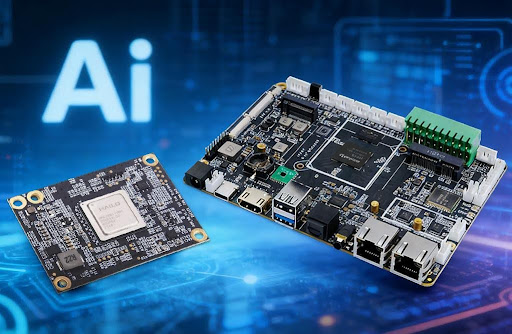
Two platforms that clearly illustrate this divergence are NXP’s i.MX95 and Rockchip’s RK3588.
Although both belong to the ARM ecosystem, they are optimized for very different priorities and deployment scenarios.
RK3588: Designed Around Multimedia-Driven AI Workloads
RK3588 has quickly become one of the most widely discussed processors in edge AI applications, largely because it aligns with how modern edge systems are actually used.
A significant portion of today’s edge AI workloads is not abstract computation—it is video-driven intelligence. Systems are analyzing camera feeds, detecting objects, tracking behavior, and generating insights in real time.
RK3588 is well suited for this environment because it integrates CPU, GPU, and NPU resources in a balanced architecture that prioritizes multimedia and AI synergy.
In practical deployments, this translates into systems such as:
- Smart retail analytics terminals that analyze customer flow and behavior
- Industrial inspection systems that detect defects in real time
- Intelligent display systems that combine content rendering with AI interaction
- Edge gateways that process multi-camera video streams locally
What makes RK3588 particularly attractive is not just its raw performance, but the way it handles mixed workloads efficiently. AI inference does not need to compete heavily with video processing, which helps maintain smoother system behavior under real-world conditions.
For many edge scenarios, this balance is more important than peak compute power.
i.MX95: A Platform Built for Long-Term Industrial Continuity
In contrast, NXP’s i.MX95 reflects a very different design philosophy.
Rather than optimizing for multimedia throughput or AI performance density, i.MX95 is designed with industrial continuity in mind. This includes long lifecycle availability, predictable system behavior, and strong emphasis on reliability under controlled operational conditions.
This makes i.MX95 particularly relevant in sectors where hardware replacement cycles are measured in years rather than product generations.
Typical applications include:
- Industrial automation systems
- Transportation infrastructure and control units
- Medical and healthcare devices
- Safety-critical embedded systems
- Factory equipment requiring long-term stability
In these environments, system behavior consistency often matters more than computational flexibility.
A key strength of i.MX95 is its alignment with industrial software ecosystems. NXP platforms are widely adopted in environments where validation cycles are long, regulatory requirements are strict, and system certification is essential.
As a result, i.MX95 is often selected not because it is the most powerful option, but because it is the most predictable.
Two Platforms Reflect Two Different Engineering Priorities
When comparing RK3588 and i.MX95 side by side, it becomes clear that they are not direct competitors in the traditional sense. Instead, they represent two distinct approaches to edge computing design.
RK3588 is oriented toward flexibility, multimedia-heavy workloads, and rapid deployment of AI-enabled devices. It is often chosen when visual processing and AI inference are central to the application.
i.MX95, on the other hand, is oriented toward stability, lifecycle assurance, and industrial predictability. It is often preferred when long-term reliability and controlled system behavior are critical.
This divergence reflects a broader trend in the embedded industry: hardware is becoming more specialized, not less.
Ecosystem and Vendor Strategy Are Becoming Decisive Factors
In real-world deployments, hardware specifications alone are no longer sufficient to evaluate a platform. Software support, ecosystem maturity, and vendor strategy increasingly determine success.
RK3588 has benefited from rapid adoption in the embedded and AI development community, particularly in applications that prioritize flexibility and multimedia integration.
Meanwhile, NXP continues to maintain strong influence in industrial markets due to its long-term support model and established ecosystem partnerships.
Rather than choosing one platform exclusively, many embedded companies are now supporting both.
For example, Geniatech is developing ARM-based SOM platforms across both RK3588 and NXP i.MX series, targeting industrial automation, edge AI systems, and embedded computing applications.
This dual-platform strategy reflects an important reality: edge computing is no longer a single-market ecosystem. It is a collection of overlapping use cases with different priorities.