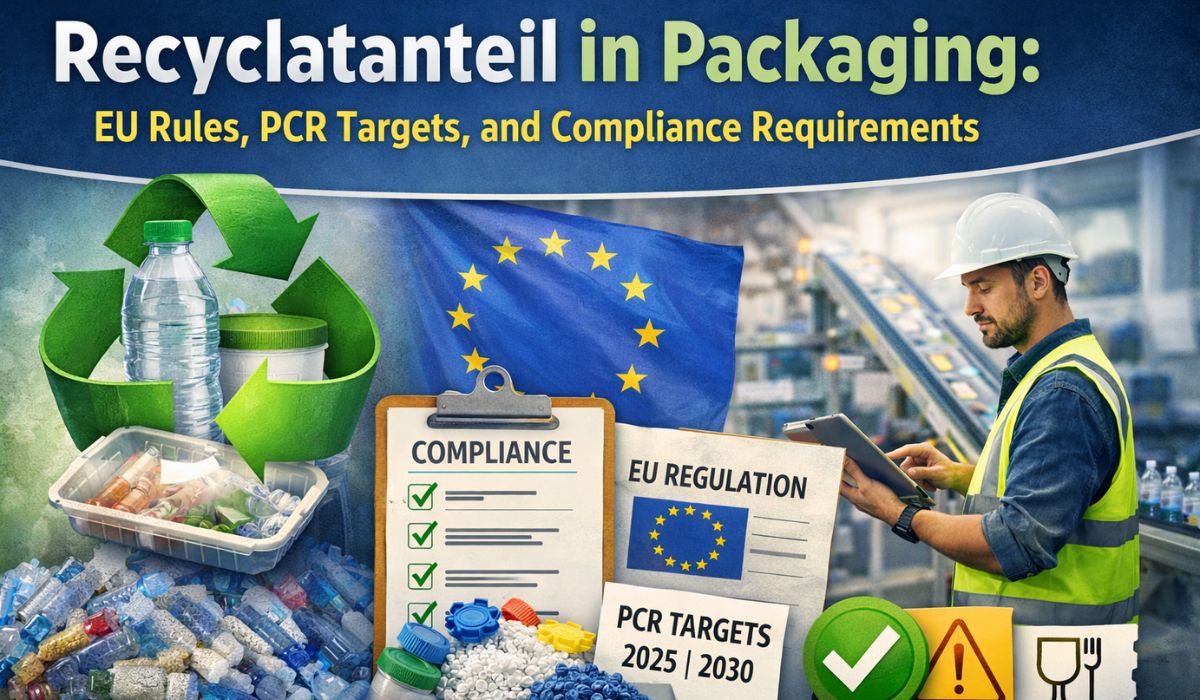
Recyclatanteil is a term used to describe the share of recycled material in a product or package. In packaging, it usually means how much post-consumer recycled plastic, often called PCR, has been added to a bottle, tray, film, cap, or other pack format. This topic matters more than ever because brands, manufacturers, and importers are under pressure to cut virgin plastic use, lower waste, and meet stricter legal rules across Europe and beyond.
For many businesses, this is no longer only an environmental goal. It is now a product design issue, a sourcing issue, a cost issue, and a legal issue at the same time. Companies that place packaging on the EU market need to understand what counts as recycled content, how it is measured, where it can be used safely, and what proof is needed during audits or market checks. A clear understanding helps avoid delays, weak claims, and expensive packaging changes later.
What Recyclatanteil Means in Practical Terms
In simple terms, Recyclatanteil tells you how much of a package comes from recycled material instead of new raw material. If a plastic bottle contains resin made partly from recovered and reprocessed waste, that recycled share is part of its recycled content. In real packaging work, the question is not only whether recycled plastic is used, but also what kind it is, where it came from, how clean it is, and whether it is allowed for the intended use.
That last point is important because not all packaging applications are treated the same way. A detergent bottle, a shipping mailer, and a yogurt cup may all use plastic, but they do not face the same technical and legal limits. Packaging that touches food usually needs stricter control, better traceability, and more testing than non-food packaging. So when companies talk about increasing recycled content, they also have to think about product safety, quality, color, odor, barrier performance, and shelf life.
Why PCR Has Become a Major Packaging Priority
PCR has become central to modern packaging because governments want to move materials in a circular system instead of sending them to landfill or incineration. Recycled plastic helps reduce dependence on virgin fossil-based feedstocks and gives waste material a second life. It also pushes the market to improve collection, sorting, and recycling systems, because stronger demand for recycled resin can support better infrastructure over time.
At the same time, consumer expectations have changed. People increasingly want packaging that looks responsible, not excessive. Many buyers now notice on-pack claims about recycled material, recyclability, refill systems, and reduced plastic use. That public pressure has encouraged brands to set internal recycled-material goals, especially for bottles, personal care packs, household containers, and e-commerce packaging. Still, good intentions are not enough. Claims need to match real composition, real records, and the actual legal framework.
ALSO READ THIS :- How Is Life After Divorce for Seung Yong Chung and Diane Farr?
The EU Rules Businesses Need to Understand
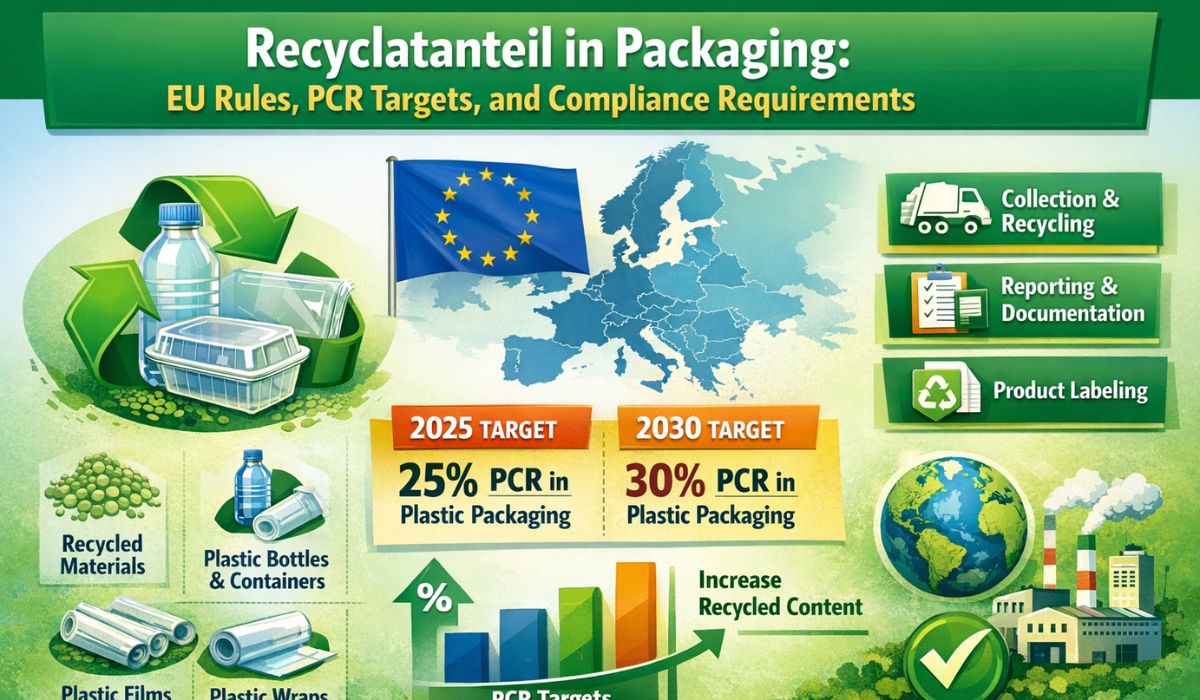
The European Union has moved from broad waste policy toward much more detailed packaging rules. The Packaging and Packaging Waste Regulation entered into force in February 2025 and generally applies from August 2026. It is designed to make packaging more recyclable, reduce unnecessary packaging, improve labeling, and increase the use of recycled plastics in packaging placed on the EU market.
Alongside that broader framework, the EU already has a well-known rule for single-use plastic beverage bottles. Under the Single-Use Plastics Directive, PET beverage bottles must contain at least 25 percent recycled plastic by 2025, and plastic beverage bottles more generally move to a 30 percent recycled content target by 2030. Those bottle rules are especially important because they created one of the clearest recycled-content obligations in the market and helped make food-grade rPET a strategic material across the packaging chain.
How the New Packaging Framework Changes the Discussion
The new EU approach is broader than a single bottle rule. It treats recycled content as part of a larger system that includes recyclability, packaging reduction, reuse in some sectors, labeling, and producer responsibility. That means businesses cannot look at recycled content in isolation. A package may include more recycled material, but it must still be functional, safe, and compatible with recycling systems. A design that harms sortability or contaminates recycling streams can create problems even if the recycled share looks high on paper.
This is why compliance teams now work much more closely with packaging engineers, procurement managers, converters, resin suppliers, and marketing departments. One team may focus on technical performance, another on declarations and legal wording, and another on commercial supply. Recyclatanteil sits in the middle of all of that. It is both a material question and a proof question, and many companies underestimate the proof side until they face customer questionnaires or regulator requests.
Food Contact Packaging Needs Extra Care
Food contact packaging is one of the hardest areas in this field. Recycled plastic can be used in food packaging, but it must meet strict EU rules intended to protect human health. The dedicated EU rules for recycled plastic materials and articles intended to come into contact with food set a framework for how recycled plastic may be produced, authorized, and placed on the market. In practice, this means not every recycled stream can automatically be used for direct food contact applications.
This is where many packaging projects slow down. A brand may want to move quickly from virgin plastic to high PCR content, but the legal pathway for food use can be narrower than expected. The company must check whether the recycling process is suitable, whether the intended packaging format falls within the allowed scope, and whether the supporting records are complete. For that reason, non-food packaging often moves faster on recycled content than food packaging, even when both use similar polymers.
What Counts as Good Compliance Evidence
Strong compliance depends on records, not assumptions. If a supplier says a resin contains recycled material, that statement should be backed by formal documentation. The business buying the material should know the recycled share, the polymer type, whether the content is post-consumer or post-industrial, the production site, and the method used to allocate and calculate the recycled share. In complex supply chains, this often involves certificates, declarations of conformity, purchase specifications, test reports, batch data, and quality agreements.
A useful way to think about compliance is to focus on a small group of core proof items:
- a clear material specification showing the recycled share
- supplier declarations that match the exact packaging grade being purchased
- traceability records for batches and manufacturing sites
- quality and safety documents for intended use, especially food contact
- internal calculations showing how recycled content is measured and reported
- artwork and claims checks so on-pack statements do not go beyond the evidence
Common Challenges Companies Face
One major challenge is supply. High-quality recycled resin is not always available in the quantity, color, or performance level that a company needs. Food-grade recycled PET can be especially tight because demand is strong and bottle targets have already pulled large volumes into the beverage sector. When supply is unstable, packaging teams may need to redesign the pack, adjust color expectations, change wall thickness, or mix grades more carefully.
Another challenge is technical performance. Recycled plastic can behave differently from virgin material. It may affect clarity, odor, stiffness, impact strength, sealing behavior, or appearance. That does not mean recycled content is a bad choice. It simply means packaging development has to be managed well. Many successful projects come from testing the full pack system early, including labels, adhesives, closures, inks, and filling conditions, instead of looking only at the base polymer.
Recyclability and Recycled Content Must Work Together
It is easy to treat recyclability and recycled content as separate ideas, but in real packaging work they are closely connected. A package made with recycled resin should still be easy to collect, sort, and recycle after use. If a pack uses problem colors, hard-to-remove sleeves, incompatible layers, or disruptive additives, it may weaken the recycling loop that future recycled material depends on. In other words, a package should help the system both before and after it reaches the consumer.
This is why leading packaging strategies look at the full life cycle. They ask practical questions. Can the package be emptied well? Will it sort correctly in existing waste streams? Does the label interfere with recycling? Can recycled resin be used without hurting function? Are there easier formats that use less material overall? The best results usually come from balancing these questions instead of chasing a single number.
How Businesses Usually Build a Realistic PCR Plan
A strong recycled-content plan starts with a packaging map. A company needs to know which pack formats it uses, in what volumes, for which markets, and with what legal restrictions. After that, the next step is usually to divide formats into three groups: easier opportunities, medium-difficulty formats, and hard cases. Non-food rigid plastic packs often offer faster gains. Multi-layer structures, direct food contact packs, and highly demanding cosmetic or medical formats usually take longer.
This step-by-step method helps avoid overpromising. It also gives procurement teams time to secure supply and gives technical teams time to test performance. Many businesses make the mistake of announcing a recycled-content target first and trying to solve the details later. A better approach is to connect public goals to realistic material availability, packaging function, and legal proof from the start.
ALSO READ THIS :- Joguart Evolution: From Early Concept to Modern-Day Relevance
Labeling and Marketing Claims Need Care
Companies also need to be careful with language used on packaging, websites, and sales materials. Saying a package is “made from recycled plastic” may sound simple, but the exact wording matters. If only part of the package contains recycled material, the claim should make that clear. If the recycled share applies only to the bottle and not the cap or label, that difference should not be hidden. If a claim refers only to a specific market version, it should not be used as if it were global.
Good claim control protects both the business and the customer. Clear wording helps prevent confusion and builds trust. It also reduces the risk of challenge from regulators, retailers, or competitors. In packaging, simple statements are often the strongest ones because they can be supported more easily and understood more clearly.
Why Global Brands Need a Wider View
Although the EU is a major driver in this area, global brands should not treat this as a Europe-only issue. Recycled-content rules, plastic taxes, producer responsibility systems, and packaging reporting requirements are growing in many parts of the world. The exact rules differ, but the direction is similar: less waste, better design, more proof, and greater use of recycled material where safe and practical. That means packaging systems built for the EU may influence product design decisions for other markets too.
For worldwide companies, this creates both pressure and opportunity. Pressure comes from having to manage different rules across regions. Opportunity comes from using one strong packaging governance model across the business. A company that builds solid traceability, supplier control, and testing methods for Europe is often in a better position when other markets tighten their own rules later.
Final Thoughts
Recyclatanteil in packaging is no longer a niche topic. It now sits at the center of product design, legal compliance, sourcing, and brand credibility. Businesses that understand the difference between ambition and evidence will be in a much stronger position than those that rely on broad promises or weak paperwork. The real goal is not simply to add recycled material, but to do it in a way that is lawful, safe, functional, and sustainable over time.
The smartest approach is practical and steady. Start with the packaging formats where progress is realistic, build proof systems early, test material performance carefully, and make claims only when they are fully supported. In a market shaped by stricter packaging rules and rising demand for PCR, that kind of disciplined work is what turns recycled content from a marketing idea into a reliable part of modern packaging.
FAQs
1. What does Recyclatanteil mean in packaging?
It means the share of recycled material used in a package or packaging component. In many cases, companies use it to describe the amount of post-consumer recycled plastic in bottles, trays, films, or closures.
2. What is PCR in packaging?
PCR stands for post-consumer recycled material. It comes from items that have already been used, collected as waste, processed, and turned back into usable raw material for new packaging or products.
3. Is recycled plastic allowed in food packaging?
Yes, but it is subject to stricter rules than non-food packaging. Businesses must make sure the recycled plastic comes from suitable processes and meets the legal requirements for food contact use.
4. Are EU beverage bottles required to contain recycled plastic?
Yes. EU rules already set specific recycled-content targets for certain plastic beverage bottles, which is why many beverage companies have invested heavily in food-grade recycled PET and stronger collection systems.
5. Is recycled content the same as recyclability?
No. Recycled content describes what the package is made from, while recyclability describes whether it can be effectively collected, sorted, and recycled after use. Good packaging should aim for both.
6. What is the biggest compliance mistake companies make?
One of the most common mistakes is making broad claims without enough proof. A business should always match its statements to supplier documents, technical records, and the exact packaging component being sold.
FOR MORE CONTENT: CLOCKMAGAZINE